



1. Bumper Mold: Technical Advantages of Internal Parting Design
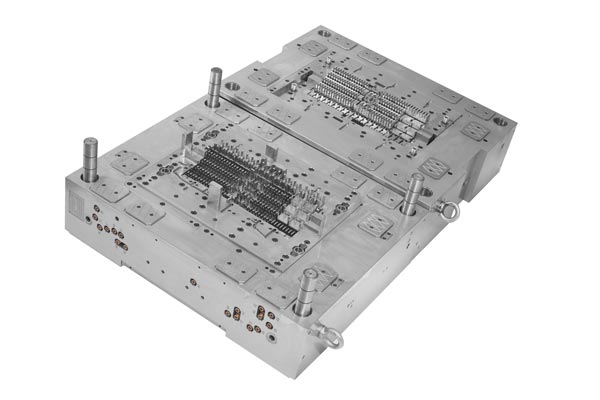
Automotive bumper molds generally adopt an internal parting overall design scheme. Compared with the traditional external parting structure, internal parting design imposes higher requirements on the overall mold strength and significantly increases structural complexity. However, it is precisely this high-threshold design that enables internal parting molds to deliver superior performance in molding accuracy, parting surface sealing, and product appearance consistency, making it the mainstream direction for mid-to-high-end bumper mold development.
2. Two Core Types of Tire Molds
Tire molds can be classified into two major categories by structural form:
The first category is segment molds, composed of three core components: tread ring, top segments, and upper and lower side plates. Based on the guiding method, segment molds are further subdivided into conical surface guided segment molds and inclined plane guided segment molds, each suited to different scenarios in terms of demolding smoothness and tread precision.
The second category is two-piece molds, which have a relatively simple structure consisting of an upper mold and a lower mold, suitable for products with lower tread precision requirements.
This article takes the technically more demanding segment mold as an example to provide a detailed breakdown of its complete manufacturing process.
3. Full Manufacturing Process of Segment Molds
Step 1: Blank Preparation and Heat Treatment. The blank is forged according to the tire mold drawing, followed by rough turning and a complete annealing treatment to thoroughly eliminate internal stress. During quenching, the workpiece must be placed flat to control deformation within the allowable range.
Step 2: Datum Machining and Semi-Finish Turning. Lifting holes are machined according to the drawing, and the diameter and height of the tread ring are machined to specification per the semi-finish turning drawing. The inner wall of the tread ring is machined using a semi-finish turning program, after which a semi-finish turning template is used for first-article inspection.
Step 3: Tread Forming. Using the finished tread electrode, the internal tread patterns on the tread ring are formed one by one through wire EDM (electrical discharge machining), with each pattern verified against a dedicated template.
Step 4: Segmentation and Marking. The tread ring is divided into equal portions according to the technical requirements of the tire mold manufacturer. Identification lines are marked on each portion, which are then loaded into a fixture for back waist hole machining and tapping.
Step 5: Laser Segmentation Cutting. Along the marked lines from Step 4, precision laser cutting is performed to ensure consistent segment dimensions.
Step 6: Tread Post-Processing. The cut tread segments are subjected to polishing, corner clearing, root clearing, and exhaust hole drilling as required by the drawing to ensure smooth gas discharge during molding.
Step 7: Polishing and Surface Treatment. The internal cavity of the tread segments undergoes uniform stainless steel polishing, with a requirement for consistent color throughout and no visible color variation.
Step 8: Final Assembly. The tread ring, top segments, and upper and lower side plates are assembled according to the assembly drawing to complete the full segment tire mold.
The above eight steps are closely interlinked. Any deviation at any stage will directly affect the final mold’s tread precision and service life, making full-process quality control essential.
FAQ
Q: What are the core advantages of internal parting molds compared to external parting molds?
A: In internal parting molds, the parting surface is located inside the product, so the parting line is not exposed on the visible surface. This results in an invisible mold seam, superior sealing performance, and higher molding accuracy. The trade-off is a more complex mold structure, with higher manufacturing difficulty and cost than external parting solutions.
Q: What is the difference between conical surface guiding and inclined plane guiding in segment molds, and how should one be selected?
A: Conical surface guiding distributes demolding force more evenly and is suitable for deep-tread, high-precision tires. Inclined plane guiding has a simpler structure and lower machining cost, making it suitable for shallow-tread applications with moderate precision requirements. Selection should be based on a comprehensive assessment of tread depth and precision grade.
Q: Why is flat placement particularly emphasized during the annealing and quenching of tire mold blanks?
A: Tire mold blanks are large in volume with uneven wall thickness. If the blank is not placed flat during quenching, the combined effect of gravity and thermal stress will cause severe bending deformation, leaving insufficient machining allowance or even resulting in outright scrap. Flat placement is a critical process discipline for controlling deformation.