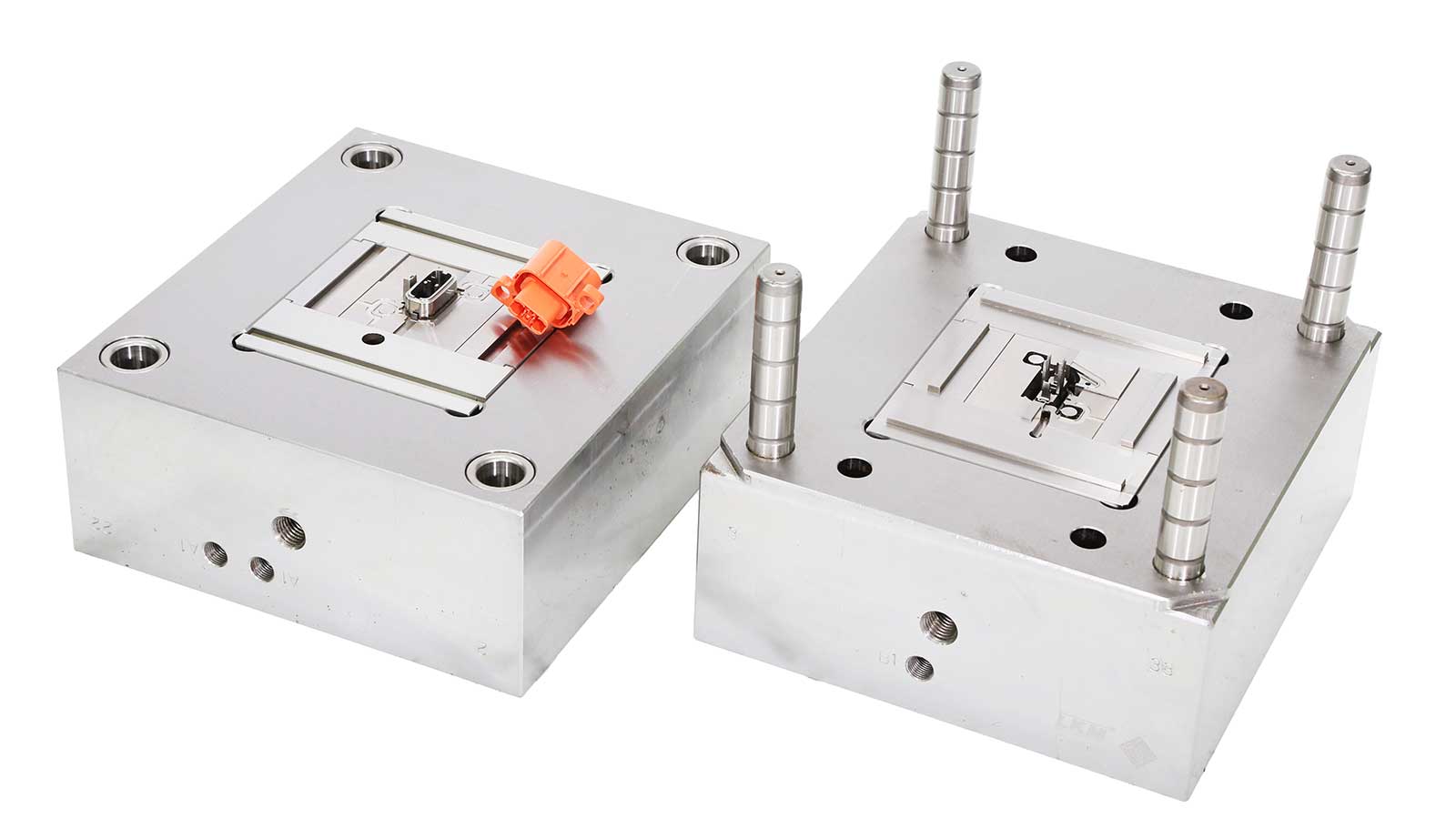





Injection mold cavity layout design is a highly systematic professional skill. Mold design engineers must have a thorough understanding of gate location, ejector pin layout, parting surface design and machining, process flow, and product appearance requirements, as well as potential product defects, in order to develop a scientific and rational layout plan.
1. Gate Location and Cavity Count: The First Step in Layout Design
Upon receiving the product design drawing and initiating mold design, the primary task is to determine the injection gate location and method. The selection of gate position directly determines product appearance quality and molding stability.
For products with irregular shapes or large dimensions, the mold typically adopts a single-cavity (1-cavity) layout to ensure uniform filling and reduce molding risks. For conventional products, engineers tend to prefer a 1-out-of-2 (2-cavity) layout, which is suitable for large sprue side gating or submarine gating processes, balancing production efficiency with appearance quality.
2. Multi-Cavity Layout: The Progressive Logic from 1-out-of-4 to 1-out-of-16
When production capacity requirements increase further, a 1-out-of-4 (4-cavity) layout becomes a common choice. Designers must focus on balancing runner length. A well-designed runner system not only effectively saves raw materials but also produces cleaner and smoother gate marks.
Building on this, layouts such as 1-out-of-6, 1-out-of-8, and even 1-out-of-16 are essentially extensions and evolutions of the 1-out-of-4 configuration. It is particularly important to note that in multi-level layout design, the runner length should be approximately twenty-five percent longer than the next level to ensure consistent filling pressure across all cavities.

3. Special Handling for Appearance Parts: Multi-Point Gating and Submarine Gating
If the product is an appearance part, large sprue gating is not recommended, as gate marks will seriously affect product aesthetics. In such cases, multi-point gating or submarine gating (pin-point gating) should be prioritized.
However, it should be noted that submarine gating carries certain risks. The product surface near the gate may exhibit flow marks or jetting, which must be fully evaluated and prevented during the design stage.
4. Parting Surface Design: Simplicity First, Machinability as the Foundation
Parting surface design is a critical element in the layout plan. Designers must thoroughly inspect undercut issues and comprehensively evaluate product structure, strength requirements, and the machinability of the parting surface.
The general principle is to use flat parting surfaces as much as possible and minimize the use of curved parting surfaces. Flat parting surfaces not only facilitate mold machining but also effectively reduce flash risks and improve product consistency.
5. From Layout to Drawing: Completing the Full Design Process
After completing all the above planning, the core mold dimensions can be determined, and all views can be drawn. All drawings must be produced at a 1:1 scale, followed by mirroring and multiplication by the product shrinkage rate. At this point, the cavity layout design for the injection mold is essentially complete.
Summary
Injection mold cavity layout design is by no means a simple spatial arrangement. It is a comprehensive decision-making process that integrates materials science, fluid dynamics, and manufacturing technology. A well-planned layout maximizes production efficiency and minimizes material waste while ensuring product quality, representing the core competency of a mold design engineer.
FAQ
Q: When should a 1-out-of-2 layout be prioritized over a 1-out-of-4 layout?
A: When the product is of conventional size with moderate appearance requirements, a 1-out-of-2 layout is the most commonly used solution as it balances efficiency and quality. When higher production capacity is needed and the product structure permits, it can be upgraded to a 1-out-of-4 layout, but attention must be paid to runner balance and pressure consistency.
Q: What are the respective advantages and disadvantages of submarine gating and large sprue gating?
A: Large sprue gating leaves visible gate marks, making it suitable for non-appearance parts. However, it offers easy gate removal and stable molding. Submarine gating produces hidden gate marks with a better appearance, making it ideal for appearance parts, but it carries a risk of flow marks and requires more complex gate finishing.
Q: Why is a flat parting surface recommended over a curved one?
A: Flat parting surfaces are easier to machine, offer better precision control, and effectively reduce the risk of flash and material leakage. Although curved parting surfaces are sometimes unavoidable for complex products, they significantly increase mold machining costs and long-term maintenance difficulty.