



In precision injection molding, thermal management represents one of the most critical factors determining final product quality, dimensional stability, and production efficiency. Maintaining an accurate, uniform mold temperature directly influences resin flow, shrinkage rates, cycle times, and the mitigation of internal stresses. Leading manufacturers employ advanced thermal engineering practices, cutting-edge cooling technologies, and closed-loop monitoring systems to ensure rigorous control over every stage of the molding process.
The Science of Thermal Equilibrium in Mold Design
Controlling mold temperature requires establishing a precise thermal equilibrium between the heat introduced by molten polymer and the heat extracted by the cooling system. Deviations in thermal uniformity can lead to defects such as warpage, sink marks, volumetric shrinkage, and mechanical weakness.
To achieve continuous thermal control, precision mold manufacturers focus on several core engineering disciplines:
-
Balanced Heat Transfer Design: Engineers calculate heat loads based on resin thermal conductivity, shot volume, and target wall thickness.
-
Cooling Fluid Optimization: Selecting the correct fluid media—such as pressurized water for temperatures up to 180°C or oil-based systems for higher thermal demands—ensures consistent energy dissipation.
-
Flow Velocity and Turbulence: Fluid flow within cooling channels is calibrated to maintain a turbulent state (high Reynolds numbers), maximizing thermal conductivity between the mold steel and the cooling medium.
Advanced Strategies for Precision Mold Temperature Control
Modern high-precision manufacturing relies on a combination of active equipment, innovative channel architectures, and real-time sensor feedback.
1. High-Performance Mold Temperature Control Units (TCUs)
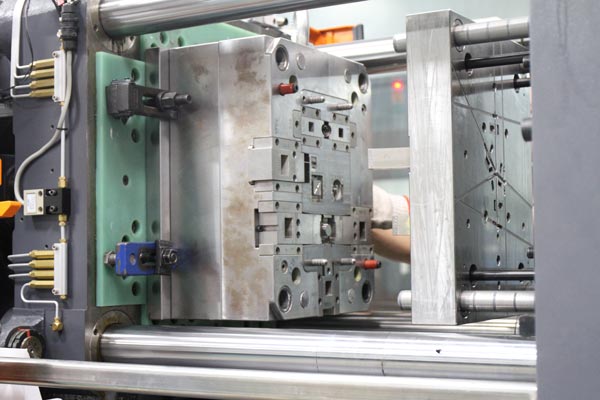
Precision molding operations utilize advanced multi-zone Mold Temperature Control Units (TCUs). These units feature high-efficiency pumps, precision heating elements, and automated valves to regulate heat-transfer fluids. By dividing the mold into distinct thermal zones, operators can independently regulate core, cavity, and runner temperatures to compensate for geometry-driven heat concentrations.
2. Conformal Cooling and Advanced Channel Architecture
Traditional straight-drilled cooling lines often struggle to provide uniform heat extraction in complex or deep-cavity molds. Precision manufacturers utilize Metal Additive Manufacturing (3D printing) to implement conformal cooling channels. These channels follow the exact contour of the part geometry, keeping distance between the cooling medium and the cavity wall consistent. Conformal cooling dramatically reduces thermal gradients, minimizes warpage, and cuts overall cycle times.
3. Dynamic Mold Temperature Control (RHCM)
Rapid Heat Cycle Molding (RHCM), also known as dynamic mold temperature control, rapidly heats the mold surface using steam or induction before injection, then quickly cools the mold prior to ejection. This technique eliminates weld lines, enhances surface gloss, and improves micro-feature replication in optical and medical components.
4. Real-Time Closed-Loop Sensor Monitoring
Accurate temperature regulation depends on real-time feedback. Thermocouples and infrared temperature sensors are integrated directly into critical core and cavity zones. Connected to central PLC systems, these sensors continuously trigger automatic flow adjustments in the TCU, maintaining surface temperature tolerances within tight ranges (often within ±0.5°C).
5. High-Thermal-Conductivity Alloys and Insulation
In high-stress areas where physical channel placement is restricted, manufacturers integrate specialized mold materials. Copper-beryllium alloys, ampcoloy inserts, and thermal insulation plates between the mold base and machine platen prevent unwanted heat dissipation into the injection press, preserving thermal energy exactly where it is needed.
Why Choose Yize Mould?
When tight tolerances, complex geometries, and flawless surface finishes are mandatory, selecting an experienced manufacturing partner is essential. Dongguan Yize Mould Co., Ltd. stands at the forefront of high-precision mold design and fabrication, providing tailor-made thermal management solutions for demanding global industries.
-
Micron-Level Engineering Expertise: Dongguan Yize Mould Co., Ltd. specializes in ultra-precision molds with machining tolerances down to 0.001mm, ensuring flawless mold assembly and consistent thermal contact.
-
Custom Conformal Cooling Integration: Yize Mould utilizes advanced thermal simulation software (Moldflow) and 3D metal printing technologies to design custom conformal cooling layouts, helping clients optimize cycle times and eliminate part distortion.
-
State-of-the-Art Manufacturing Facilities: Equipped with high-precision CNC machines, mirror EDM equipment, and advanced testing instruments, Dongguan Yize Mould Co., Ltd. guarantees uncompromising quality control across every mold component.
-
Comprehensive ISO Quality Assurance: Yize Mould operates under strict ISO 9001 and IATF 16949 standards, delivering full thermal testing validation and trial-molding reports to ensure immediate production readiness.
Frequently Asked Questions (FAQs)
What is the ideal mold temperature tolerance for precision components?
For ultra-precision components in medical, automotive, and micro-electronics industries, mold surface temperature tolerances are typically held within ±0.5°C to ±1°C across all cavity areas to prevent non-uniform shrinkage and dimensional variation.
How does conformal cooling differ from conventional cooling lines?
Conventional cooling lines consist of straight drilled holes, which cannot mirror complex curved geometries. Conformal cooling channels are 3D-printed to curve around complex part contours at a uniform distance, ensuring balanced heat removal and significantly reduced cooling cycle times.
How does Dongguan Yize Mould Co., Ltd. verify thermal performance before mold production?
Dongguan Yize Mould Co., Ltd. uses high-end CAE thermal simulation tools during the design phase to analyze melt front behavior, heat accumulation, and cooling efficiency. This pre-production validation ensures the physical mold delivers optimal thermal uniformity upon trial.